Definition of innovative medicine
The candidate list of innovative medicines in the Hong Kong setting was generated from horizon scanning conducted up to 31 December 2024. Only those medicines with Phase III trial evidence were considered eligible for inclusion and were subsequently included in this analysis.
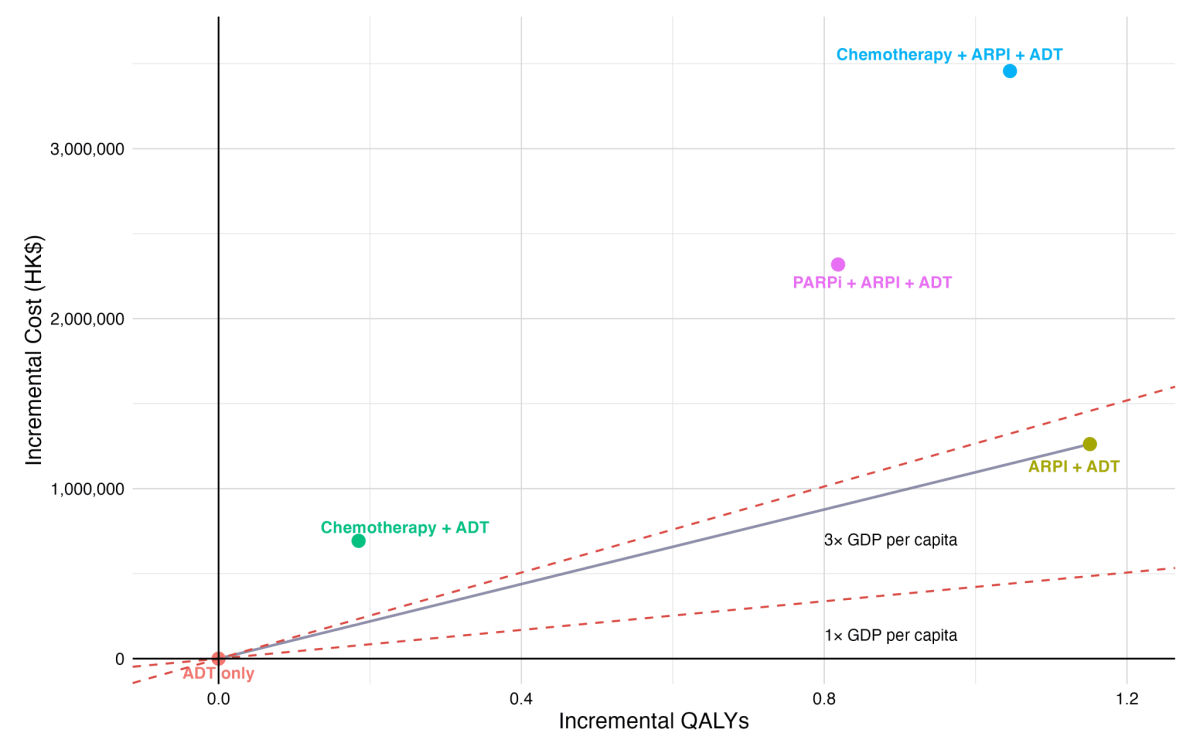
The cost-effectiveness frontier included ADT only and ARPI + ADT. This indicates that these strategies were non-dominated options in the incremental cost-effectiveness analysis. Compared with ADT only, ARPI + ADT had an ICER of HK$1,096,535 per QALY. This was above one times GDP per capita (HK$421,990 per QALY), but below three times GDP per capita in Hong Kong (HK$1,265,970 per QALY).
Note:
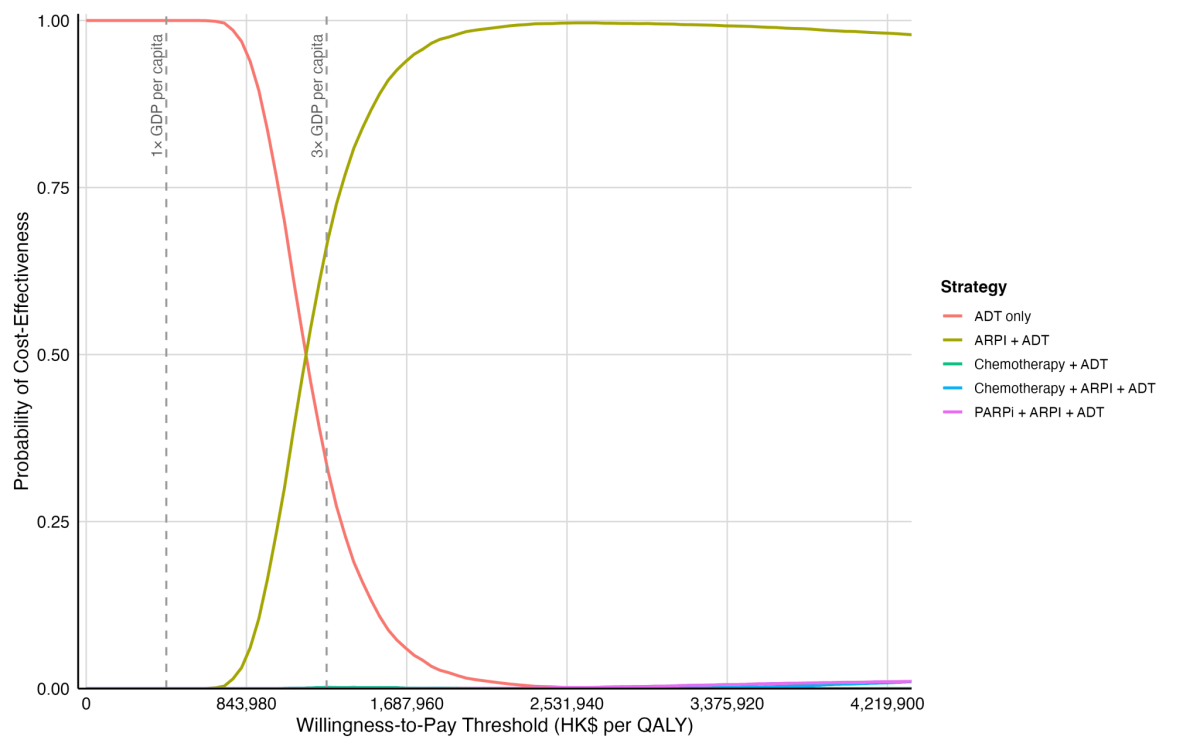
The cost-effectiveness acceptability curves summarise uncertainty in cost-effectiveness across different WTP thresholds. At the threshold of three times GDP per capita in Hong Kong (HK$1,265,970 per QALY), ARPI + ADT had a 62.0% probability of being the most cost-effective option, while Chemotherapy + ADT strategie had negligible probabilities (0.94%).
Note:
Abbreviations: ADT only, androgen deprivation therapy only strategy; ARPI + ADT, androgen receptor pathway inhibitor combined with ADT; Chemotherapy + ADT, chemotherapy combined with ADT; Chemotherapy + ARPI + ADT, chemotherapy combined with ARPI and ADT; PARPi, poly(adenosine diphosphate-ribose) polymerase inhibitor; PARPi + ARPI + ADT, PARP inhibitor combined with ARPI and ADT; GDP, gross domestic product; QALY, quality-adjusted life year; WTP, willingness-to-pay.
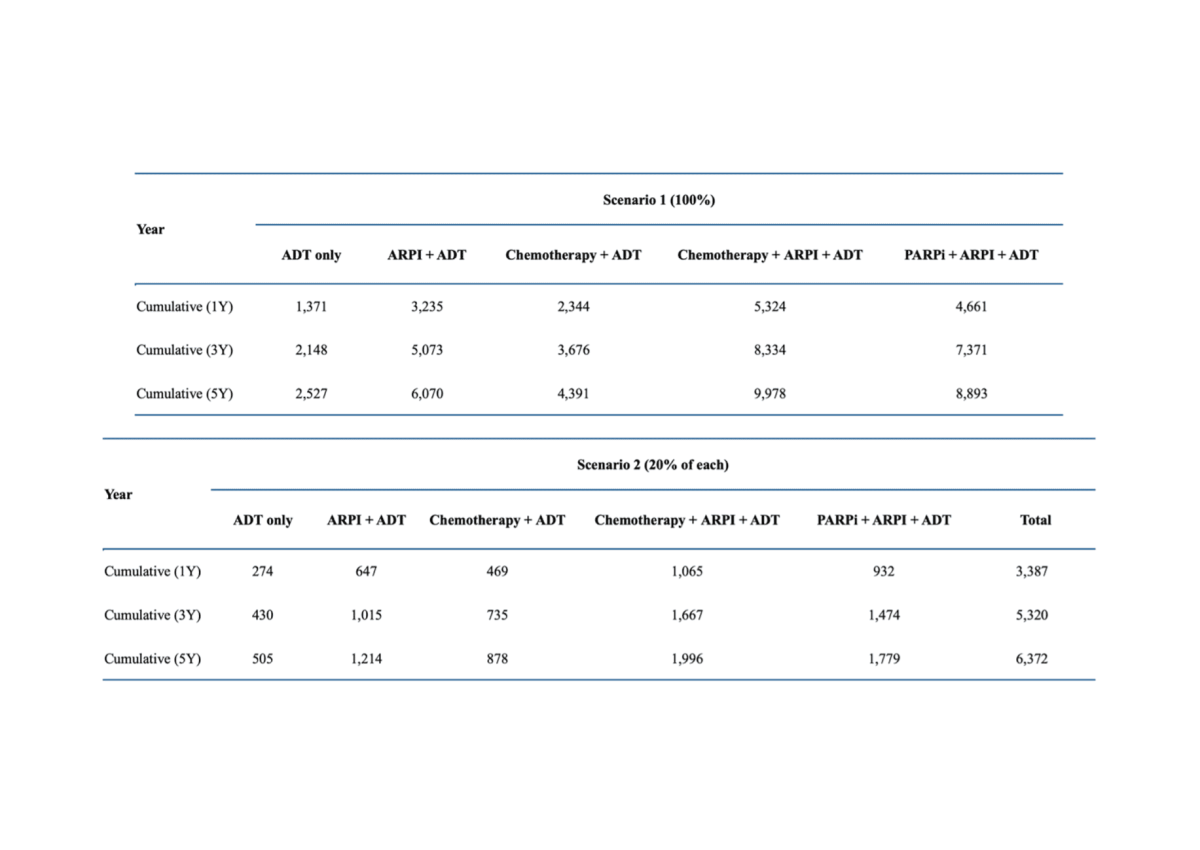
The target population comprised patients with metastatic hormone-sensitive prostate cancer (mHSPC) in Hong Kong, identified from the territory-wide electronic medical database managed by Hong Kong Hospital Authority. At model entry in 2024, the baseline prevalent population was 2,200 patients. The annual incident cohorts entering the budget impact model in 2025–2029 were projected to be 762, 788, 815, 841, and 867, respectively.
Two market share scenarios were assessed to illustrate a range of possible uptake for each treatment strategy among patients in the treatment pathway.
Abbreviations: ADT only, androgen deprivation therapy only strategy; ARPI + ADT, androgen receptor pathway inhibitor combined with ADT; Chemotherapy + ADT, chemotherapy combined with ADT; Chemotherapy + ARPI + ADT, chemotherapy combined with ARPI and ADT; PARPi, poly(adenosine diphosphate-ribose) polymerase inhibitor; PARPi + ARPI + ADT, PARP inhibitor combined with ARPI and ADT.