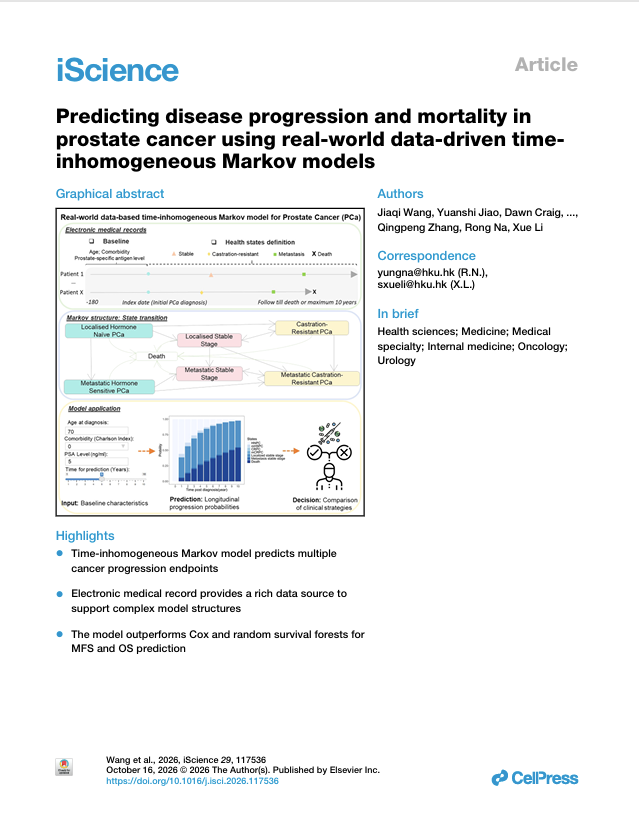


Highlights
• Time-inhomogeneous Markov model predicts multiple cancer progression endpoints
• Electronic medical record provides a rich data source to support complex model structures
• The model outperforms Cox and random survival forests for MFS and OS prediction
SUMMARY
Prostate cancer progression varies across patients. Understanding disease trajectories and mortality risk is important for improved healthcare. This study developed a time-inhomogeneous Markov model using territory-wide electronic medical records from Hong Kong to estimate 10-year disease progression. The model was constructed using data from 3,274 patients newly diagnosed in 2010–2012. Their electronic medical records defined baseline covariates (age, Charlson Comorbidity Index [CCI], and prostate-specific antigen [PSA] level) and time-varying health states. Mild cases (age≤65, CCI = 0, PSA≤4 ng/mL) were predicted to have 16.9% and 28.0% mortality at five and ten years. Evaluated on an independent 2013 cohort, our model showed strong prediction performance for metastasis-free survival (concordance index [C-index]: 0.780; 95% confidence interval [CI]: 0.723–0.837) and overall survival (C-index: 0.787; 95% CI: 0.731–0.843), exceeding Cox proportional hazards and random survival forest models. This study provides a pragmatic tool for long-term progression risk prediction and health economic evaluation.